Posts tagged: Open Data

OA in the UK

- 0 Comments

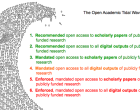
From 1 April 2013, all academics funded by Research Councils UK (RCUK) need to be compliant with a new open access policy. The policy requires grantees to make their research available via open access – either immediately via open access (OA) publishing, or via OA deposit of the author version in an archive –typically with an embargo period.

Immediate OA via OA publishing is the route strongly preferred by the research councils, and to reduce barriers to OA publishing, dedicated funds have been made available to all universities which receive RCUK funding to cover article processing charges.

The policy was announced last summer. Since then we have seen reams of media coverage, and more recently, a flurry of public …

Read more

Social coding and scholarly communication – open for collaboration

- 1 Comment

Innovation in how social online tools and their features develop is frequently defined and driven by the network’s users. A collaboration between BioMed Central, some of our authors and editors, and the team behind a powerful social software development platform aims to stimulate innovation in scholarly communication.

The ‘social coding’ website, GitHub, was founded in 2008 and its primary aim is to enable users to publicly or privately share source code, and manage software development projects. But it seems that life scientists have had other ideas for quite some time.

Bioinformaticians – one of BioMed Central’s earliest and largest author groups – by definition must create and share software for life science projects. Many BioMed Central journals urge authors …

Read more

Version control for scientific research

- 3 Comments

Guest blog post from Dr Karthik Ram (KR) and Dr C. Titus Brown (CTB) who have been working with BioMed Central on our recently announced collaboration with the social coding repository, GitHub.

We live in an increasingly collaborative era, where the Internet enables distance collaboration almost trivially – not just with e-mail and videoconferencing, but with collaborative realtime document editing and networked transmission of data and analyses. These tools allow us to collectively leverage many resources to rapidly solve problems and ultimately accelerate scientific discovery. While these tools and technologies are fundamentally changing how we collaborate on science, there is still considerable room for improvement in how we are using them.

Programmers, and especially the world of open source software …

Read more

BioMed Central support for data publishing: enhanced handling of additional files

- 0 Comments

At BioMed Central, we encourage authors to submit additional files such as movies and datasets, and we continue to look for ways to use web technology to make these files more useful and accessible.

We have recently updated our Instructions for Authors, adding an additional file quick reference guide, which provides advice, recommendations and examples for the preparation of various types of additional file. The guide also describes what we currently do to present each type of additional file in a readily accessible way. Examples range from interactive images to enhanced 3D PDFs, chemical structures and cut-and-paste-enabled mathematical formulae. We hope the guide will encourage authors to take full advantage of the data-sharing opportunities offered by the BioMed Central …

Read more

Open Data Award 2012: get your votes in now!

- 1 Comment

There’s just under two weeks left to put your nominations in for BioMed Central’s 7th Annual Research Awards, including the Open Data Award. This award recognizes researchers who have published in BioMed Central journals and have demonstrated leadership in the sharing, standardization, publication, or re-use of biomedical research data during 2012. Nominations close on January 31st 2013. The award will be judged by prominent figures in open data and open science: John Wilbanks; Peter Murray-Rust; Earl Beutler; Rufus Pollock and Cameron Neylon.

The award is sponsored by LabArchives, a leading Electronic Lab Notebook  that is used by scientists throughout the world to store, organize, share, and publish their laboratory data.  BioMed Central has partnered

Read more

Current Controlled Trials and DOIs – another important step towards Threaded Publications

- 0 Comments

The introduction of digital object identifiers (DOIs) to all ISRCTN records in the Current Controlled Trials database, announced today, is an essential part of achieving the aims of the Threaded Publications initiative – making the medical literature more transparent and better connected.

Prospective trial registration should be the first step in transparently disseminating all scientifically relevant information about a clinical trial. Trials can be very expensive to carry out, involve large numbers of subjects and investigators, and generate large amounts of data potentially constituting several scientific articles. The articles from the third International Stroke Trial are a case in point. But unfortunately many clinical trial-related articles are not published, leading to bias in …

Read more

DOIs and ISRCTN records – Improving permanency of clinical research

- 0 Comments

Current Controlled Trials (CCT) has introduced digital object identifiers (DOIs) to all ISRCTN records. DOIs issued by the organisation CrossRef are unique alphanumeric ID assigned to a digital object, such as an electronic journal, article, report, thesis or a clinical trial record. A DOI serves as a stable, persistent link to the full-text of an electronic item on the internet. The journal or article website address can change over time but a DOI is permanent. DOIs are widely used by academic publishers for helping to ensure the permanence, discoverability and citability of scholarly content published on the web.

A trial ID such as the ISRCTN uniquely identifies a clinical trial. Introduction of a DOI (made …

Read more

Highlighting the best open access research: BioMed Central’s 7th Annual Research Awards

- 0 Comments

It’s that time of year again! Nominations are open for you to put forward your favorite BioMed Central open access research article for our seventh annual Research Awards. Articles must be published in one of our 240 plus BioMed Central journals, during 2012 to qualify.

BioMed Central’s Research Awards have been successfully highlighting the very best research that has been made available through open access publishing for the last six years, chosen by you and selected by internationally renowned judges.

This year we’ve taken a closer look at our ten category awards and refined subject areas . Each award now allows us to distinguish the articles that deserve recognition across several disciplines.

These categories are:

Cancer
Public Health and Health …

Read more

How far have we got with public disclosure of trial data?

- 1 Comment

BioMed Central in collaboration with an Ottawa-based researcher has received the Committee on Publication Ethics (COPE) research grant for a timely project which aims to facilitate wider sharing of clinical research data.

In the last few weeks GlaxoSmithKline and Medtronic have made public commitments to share data from clinical trials they have sponsored, the BMJ have strengthened their policy on data sharing for clinical trial submissions, and Ben Goldacre‘s latest book, Bad Pharma, is causing something of a stir. These are significant and much-needed developments in transparency in clinical research.

Researchers working with human subjects are amongst the least likely to share their data, and the practicalities and legalities of sharing clinical data while …

Read more

Confronting the scale and complexity of big data: a new thematic series

- 0 Comments

Guest blog post by Prof Jason Moore, co-Editor-in-Chief of BioData Mining, a journal which publishes research on data mining applied to high-dimensional biological and biomedical data. Jason is Professor of Genetics at Dartmouth College and Director of the Institute for Quantitative Biomedical Sciences; his research focuses on understanding how DNA sequence variations increase or decrease susceptibility to common diseases.

A rapid increase in the amount of data produced by the life sciences, has led to a new era of ‘big data’. Much work has been completed in recent years to address issues such as the storage and curation of large amounts of data, and progress has been made with encouraging researchers to deposit …

Read more